Solodia
And Their Children After ThemSolodia is a large industrial-cleanup company whose contract to deal with derelict housing in the valley turns the abandoned property of the old steel mills into a site of demolition work. Through its Metalor account, it provides Hacine with temporary employment and organizes the physical dismantling and removal of the buildings’ materials.
Company and Contract
Solodia wins the bid to address the neglected residential properties owned by the old steel mills. The mills had owned dozens of homes across the valley, from small workers’ row houses to larger buildings for engineers and bosses. After the shutdown, the properties were left to deteriorate; only after a long delay did Metalor’s holding company recognize its responsibility and decide to deal with them. Solodia’s successful bid brings it at least three years’ worth of work.
The contract places the company within the industrial landscape left behind by the mills: the housing was built for the workforce and hierarchy of the steel industry, while its deterioration becomes the basis for a new cleanup job. Solodia’s role here is practical rather than restorative. The work described begins by breaking apart the buildings and clearing their remains.
Work on the Metalor Account
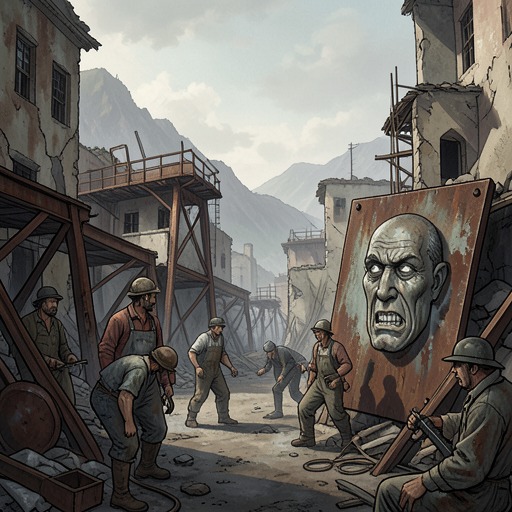
Hacine gets a temporary job with Solodia after initially living at his father’s place. In the morning, he and two or three other men arrive at a building with buckets, sledgehammers, and crowbars and begin smashing its interior. They knock down plaster panels, break brick walls, and rip out old lead plumbing. The first phase can feel like a demolition derby: a wall comes down, and a kick of the heel can topple what remains.
That exhilaration gives way to a more laborious routine. By noon, little is left to see through the thick dust, and the men protect themselves with paper masks. Once the initial demolition is complete, they clear the rubble in rotating groups: some fill the buckets while others carry and empty them into a dump truck. Beams and pipes are shouldered out by hand. The account thus shows cleanup as both destructive and repetitive, moving from the spectacle of a falling wall to the shared physical effort of hauling debris.
Labor and Organization
Solodia’s work is carried out by a small crew, with practical authority exercised on site. Hacine initially works at an extreme pace, running up stairways and hurrying to finish. Jacques takes him aside; although Jacques is not the boss and earns little more than the others, he is the person who gives orders. The scene distinguishes formal status from immediate workplace authority without specifying Solodia’s wider management structure.
The job’s temporary character and demanding manual routine define what the company means in Hacine’s life at this point: access to work through the cleanup contract, and days spent dismantling buildings that have been allowed to decay. Solodia’s account links the valley’s industrial decline to a new form of labor, in which the built environment left by the steel mills is broken down and carted away.